Agentic Treasury: What it is and what works

Agentic treasury is the use of AI agents that work through corporate treasury tasks on their own.
I could write a book with my thoughts on this. We did write one in April, How to do AI Cash Flow Forecasting, but that one is about forecasting specifically, and a lot has happened since. So this article is my latest thinking on the bigger picture: what I have picked up building an agentic treasury platform and rolling it out with treasury teams.
So what is an AI agent, really?
You have probably used ChatGPT or Claude. You ask something, you get an answer. That is a chat assistant.
An agent goes a step further. Give Claude Code or Codex a task like "find the errors in this forecast model" and it opens the files, reads the formulas, runs some checks, notices something odd, digs a bit deeper and comes back with a list. You did not tell it where to look. It worked out the steps by itself and kept going until it was done.
So if you ask Claude or ChatGPT to help with a treasury task, is that agentic treasury?
Technically, maybe yes. But there are quite a few things to watch out for, and I will get to those. Let's first go through the use cases, and then look at the options you have. Those mostly come down to the classic choice: buy a specialised agentic treasury platform, or build it yourself with something like Claude Code or Codex.
The use cases I have seen work
I have seen a thousand articles summing up use cases for agents in corporate treasury (with a lot of repetition, too). So I will only go through the ones I have seen myself delivering the most results for treasury teams.
Connectivity and data automation
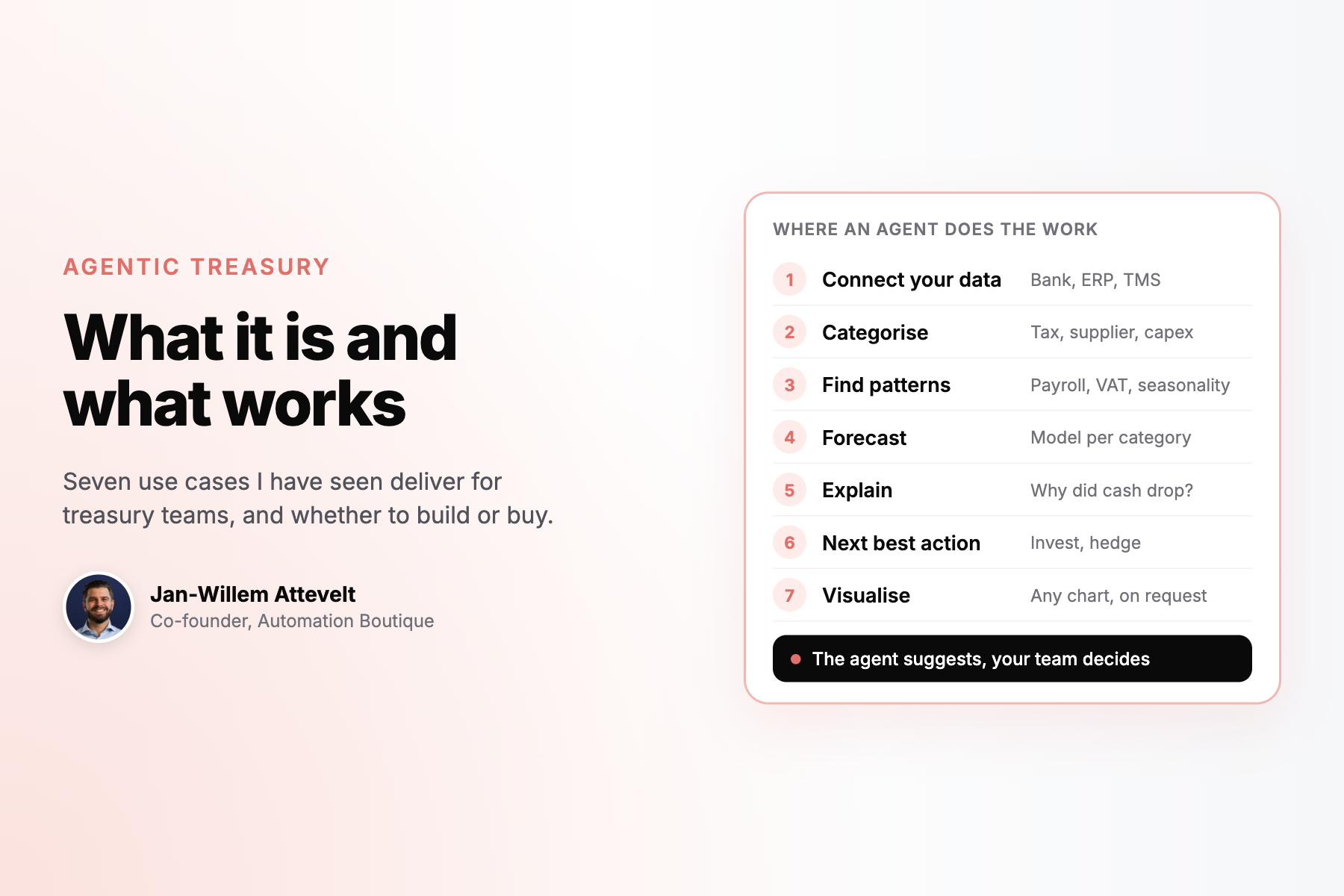
An agent can easily connect to your different systems (bank, ERP, TMS) and get data out or in. You can automate the different data streams, so the statements and open invoices are just there every morning. It is the least exciting use case, and everything else depends on it.
Categorising your data in a smart way
If you look at your bank statement data, you cannot spot with the naked eye where all your money is going to and who you are receiving it from. An agent can help you build a categorisation engine that automatically determines whether a cash flow is a tax payment, a payment to a supplier, capex, and so on.
This is useful because it lets the treasurer explain the movements in cash easily. And it is the base for everything that comes after.
Detecting seasonality and patterns
Once the cash flows have a category, an agent can go through your history and find the patterns. Payroll at the end of every month. VAT every quarter. Holiday pay in May. Customers who pay less in August, and that one big customer who is always two weeks late (but always pays).
You probably know half of these by heart. The agent finds all of them, per category and per company, and also tells you which cash flows are stable enough to predict and which are not.
Cash flow forecasting
This is the one everybody asks about.
The way our agent does it in NineAnts: for every cash flow category, it backtests several statistical models on your own history. It hides the last months, lets each model predict them, and checks which one came closest. The best model per category wins. Payroll and customer receipts behave completely differently, so it makes no sense to use one model for both.
But history alone is not enough. The forecast needs to work together with other data sources, like the known cash flows from your ERP (open invoices, payment runs, payroll). And it needs to work together with the treasurer. You know the dividend goes out in June and the new machine is paid in three instalments. The agent does not, until you tell it.
Answering questions about your data
Why did liquidity at a certain subsidiary drop last month? Why is there such a big deviation between actuals and forecast in week 32?
Normally that is an hour of filtering and pivot tables. An agent can analyse and explain it quickly: it pulls the transactions, compares them with what is normal for that category, and points you to the ones that caused it. You still check it, of course. It just takes five minutes.
Determining the next best action
An agent can easily spot what the most desirable actions would be from a treasury perspective. Investing your excess cash: how much, where and for how long. Hedging your foreign currency exposure: how big it is, and which products to consider.
The agent suggests, and your team decides whether to execute the transaction or not.
Building your data visualisation
You can also do this in Excel or Power BI. But why not just tell the agent what kind of graph you want to see, and see it immediately? With an agent it becomes much easier to build dashboards and reports with the data you want to see.
For which use cases is Claude or ChatGPT smart?
Context matters.
The regular chat interface of these tools usually does not have a lot of context. It sees what you paste in, and that is it.
Moving up from the regular version to Claude Code or Codex, and having it work on your own context (your Excel files, for example), is already a big step up. Because now it knows your situation much better and it can produce really impressive results. Try asking it to find the errors in an Excel model you rely on.
A word of caution, though. The regular versions of these tools are officially not meant for business use. So you at least need a Team or Business subscription. And even then, your company needs to explicitly agree on using these tools, because sensitive company data gets sent to the data centres of OpenAI, Anthropic or another AI provider.
Why I would not run my treasury on it
Claude Code is, for me personally, the most powerful software I have ever used. Still, I would not want to use it in my treasury team for the majority of the processes, unless I committed to building the solutions in-house.
Using Claude or ChatGPT ad hoc for recurring treasury work is risky. Ask the same question twice and you can get two different calculations. The language model does the maths itself, and it is better at language than at keeping track of a decimal point. There is no audit trail, so six months later nobody can show how a number was made. It does not remember your categories, your buffer or your hedging policy unless you explain them again. And usually one colleague built the clever workflow, so when they go on holiday, nobody knows how it works.
You can solve all of that if you build it properly: fixed tools for the calculations, logging, tests, someone who owns it. Some companies should do exactly that. Just know that you are then running a software project.
Why buy a specialised platform, and what to look for
I know most treasury software vendors are now trying to bolt some form of AI onto their products. But not every AI "agent" is created equal.
Look at the agent's context. To which data does it have access, and does it know the relationships between your different data? Can it only read, or can it also create data? Does it have memory? When it forecasts, can you guide it, or does it only rely on historical patterns? Does it offer a human-in-the-loop mechanism? Can you set its autonomy, per type of action? Can it work unattended and do certain tasks on its own, like running the forecast on Monday morning before the team is in?
And ask who does the maths: the language model, or proper treasury tools that give the same answer every time.
A quick look at the market
If you are a traditional TMS that has been around for many years, you probably have quite some legacy technology in the platform. That makes it hard to bolt a very capable AI agent on top. It can be done, it just takes a lot of work.
Roughly, this is what the market looks like today, based on what the vendors publish themselves.
The established platforms are adding agents. Kyriba launched TAI, built on its own embedded language model. Ripple Treasury (formerly GTreasury) has GSmart agents you can run manually, semi-autonomously or autonomously per workflow. HighRadius uses automated machine learning to choose from over 100 forecasting models. These are broad platforms, built for large groups.
Then there are platforms that started from bank data. Trovata has a library of AI agents on top of its bank connectivity, and Atlar offers ready-made agents that take no action without approval.
And there is a group of newer, AI-native players. Nilus has agents across treasury, receivables and payables. Panax has agents for categorisation, reconciliation, forecasting and reporting, plus a no-code agent builder. Palm sits as an AI layer on top of your existing TMS or ERP. Bond goes furthest: its agents execute payments, FX and investments within the mandates you give them.
Whether you want that last one is a real choice. For now, I think most teams are better off with an agent that prepares the decision and a person who makes it.
If you want the details side by side, we keep a comparison of treasury AI platforms.
How we do it at NineAnts
NineAnts was born exactly when the first AI coding agents came out. So it was built from an agent-first perspective from day one. Going back to the use cases:
Connectivity. NineAnts connects to banks through premium bank APIs and encrypted SFTP (CAMT and MT940), and to PSPs, ERP and accounting systems and existing TMS platforms. Most clients are live within a week.
Categorisation. The AI proposes readable rules, your team approves them. In one implementation it learned the treasury team's own logic from 181,031 historical decisions. It now categorises more than 95% of transactions automatically (the team's Excel formulas managed 58%). Manual work went down to about a third.
Patterns and forecasting. A bottom-up forecast per cash flow category, with the best model selected per category through backtesting, combined with the known flows from your systems and your own input. Every forecast version is locked, so you can see how accurate it was against actuals.
Questions and next best action. The Treasury AI Agent answers questions on your own data, and finds excess cash, upcoming shortages and FX exposure. It identifies actions in line with your treasury policy, using deterministic treasury tools for the calculations. It explains its reasoning and logs every step. You set per action what it may do on its own, and anything that moves money stays with your team.
Dashboards. Ask for the chart you want.
Frequently asked questions
What is agentic treasury?
Agentic treasury is the use of AI agents that work through corporate treasury tasks on their own. An agent gets your bank and ERP data in, categorises and forecasts your cash flows, answers questions about them and suggests next steps, within limits your treasury team sets.
Is using ChatGPT or Claude for treasury the same as agentic treasury?
Technically it can be, especially with agent tools like Claude Code or Codex working on your own files. For recurring processes it is risky: answers can differ between runs, the model does the maths itself and there is no audit trail. It works well for one-off analysis, with a business subscription and your company's approval.
Is agentic treasury the same as autonomous treasury?
No. In agentic treasury the agent analyses and suggests, and only acts on its own where you allow it. Autonomous treasury means the agent also executes payments, FX trades or investments. Most teams start agentic and decide per action how far they want to go.
Should we build our own treasury agent or buy one?
Build it if you are ready to run it as a software project, with fixed tools for the calculations, logging, tests and an owner. Buy if you want the result without the project. Either way, check what context the agent has, who does the maths, and whether you can set its autonomy per action.
And if you want to go deeper on the forecasting part, the book is still there.